Thursday, April 9, 2020

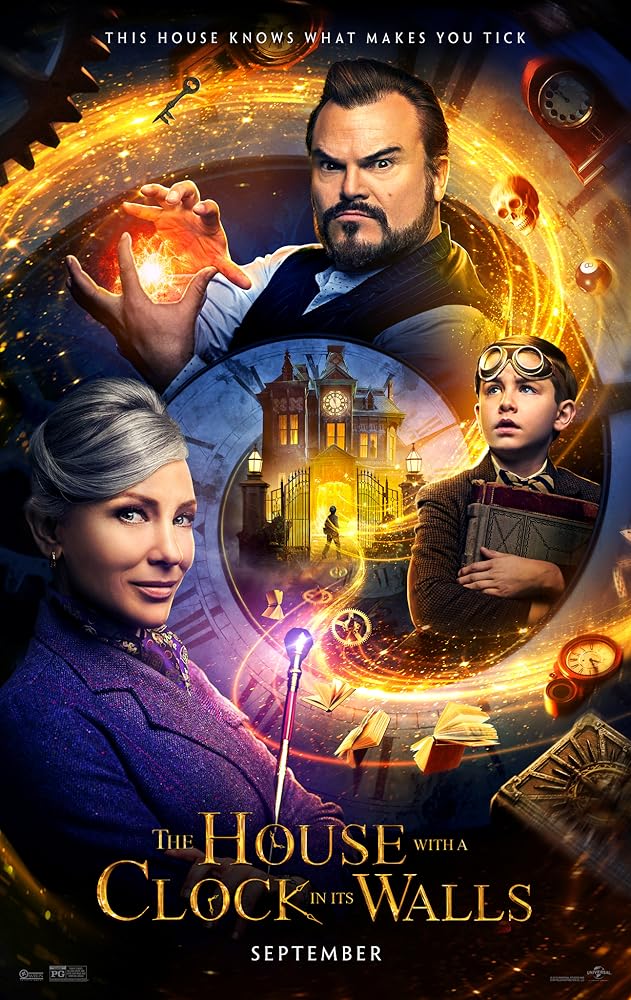
The House With A Clock In Its Walls Is A Charming And Welcome Detour From Director Eli Roth's Previous Works


 Cate Blanchett, Jack Black, and Owen Vaccaro in The House with a Clock in Its Walls (2018)

       Making a family-friendly film is a tricky task in itself as the overall story must not only appeal to young audiences, but also manage a way to entertain adults as well. To pull off such a daunting task requires a filmmaker, who can give the story the right flavor to translate onto the big screen. In the case of The House With A Clock In Its Walls, that filmmaker is Hostel's Eli Roth strangely enough. To horror fans and movie buffs, Eli Roth is both the most unusual and unlikely person to handle such a kid-friendly project as his previous works are horror films that relied heavily on gratuitous gore and nudity for maximum shock value. Strangely enough to everyone's surprise, Roth proves to be an effective choice for the directors chair as he manages to deliver a family-friendly experience that's both fun and full of numerous tricks of its own. The House With A Clock In Its Walls has much to offer in regards to being charming, fun, imaginative, and ultimately heartfelt with its message directed at young children about embracing one's weirdness with no shame in doing so.


      Based on John Bellair's best-selling children's book, the plot for The House With A Clock In Its Walls takes place in 1955 and centers around a young boy (Played by Owen Vaxcaro) whose parents are tragically killed in a car crash with him ultimately being sent to Michigan to live with his estranged uncle (Played brilliantly by Jack Black). Once he arrives, he quickly learns about some special secrets that his uncle has kept from the family circle. What audiences easily expected to end up becoming a disaster in the making due to what seemed like a clear misplacing of its director at the helm, turns out to be a genuine treat for audiences both young and old. It also helps that he has the talents of both Jack Black and Cate Blanchett to help balance things out with his surprisingly gentle and fun-spirited approach to bringing this story to life. The House With A Clock In It's Walls is entertaining, mystical, innocent, and charming in the way it presents its story to the audience with the cast appearing as if they're getting a kick out of the overall experience. The movie has an admirable blend of both humor and horror mixed together, which results in a experience that proves to be undeniably fun, along with providing a much welcomed detour for its controversial director from the gore heavy horror films he generally tackles. For audiences, its hard to look at this film and not admire both its innocence as well as its desire to charm the pants off those watching it. For young audiences, this film has all the right elements for them to get engulfed in its story with the adding of both Jack Black and Cate Blanchett in the roles of the main characters to make it appealing for older audiences as well. Not to mention it works great as being a film that's best enjoyed around the fall season, particularly Halloween time.


      The performances presented here are key to making this story work along with giving the film the large dose of heart that's needed to make it work. To state the obvious, the acting here is both convincing and full of energy from everyone involved, making the film loads of fun for those watching it. As usual, Jack Black is terrific in the role of Lewis uncle and Warlock Jonathan Barnavelt. Black is no stranger to doing kids films as his work on both
Goosebumps movies benefits his work here. He brings the appropriate balance of fun and seriousness to the role, making both his character and the plot come across as being believable while clearly having a blast with his character. The same can be said about Cate Blanchett in the role as Jonathan's neighbor and witch Florence Zimmerman. Blanchett does well with counterbalancing Black's characters extreme and good nature with her more serious and stern tone. The one performance however, that proves to be most impressive besides Blacks and Blanchett's is Owen Vaccaro as Jonathan's 10 year-old orphaned nephew Lewis Barnavelt. Vaccaro creates a likable and sympathetic young character with him perfectly portraying Lewis as being a social outcast with a desire/desperation to fit in with the other kids, even going as far as disobeying his uncle's wishes in doing so. Vaccaro's performance is not only charming but works well with Blacks and Blanchett's with the three ultimately showcasing strong chemistry. In the films main antagonists roles, Kyle MacLachlan and Renee Elise Goldsberry both shine as the evil warlock Isaac Izard and Isaac's wife Selena, whose also an evil witch. Other noteworthy supporting roles are Sunny Suljic as Lewis popular classmate Tarby, whom he tries to be friends with despite the latter being fake, Colleen Camp as Jonathan's nosey neighbor Mrs. Hanchett, Lorenza Izzo as Lewis mother Lorenza in his dream sequences, and Vanessa Anne Williams as Lewis classmate and love interest Rose. The cast goes does much in regards to making this a fun experience for audiences as they each give the film a shot of energy, that makes the whole experience even more enjoyable. This clearly looked as if it was a fun project to be apart of and the cast looked as if they made the most of their experience being in the film.


      In terms of directing, Eli Roth completely shocks and impresses with his efforts here as this type of film is not one that he normally chooses to make, but proves to be a welcomed change as he's able to extend his profile outside of graphic films such as Cabin Fever, Hostel, and the 2018 remake of Death Wish. Roth gives the film a mysterious and spooky atmosphere that makes it feel like a Halloween film, along with it feeling like a traditional children's movie made from the 90s era. The costume and set design both feel perfect for the film with the interior scenes of the house carrying an authentic look with their wooden design and supernatural decorations being stunning to look at. The stories central location, which is a haunted house is given a solid and well-designed look that feels just right for the characters and story. The visual effects used in the film are not groundbreaking by any means with some obvious moments appearing to come across as looking fake (CGI baby Jack Black for example), but their overall use makes them reasonably decent, particularly the films third act when all the monsters and creatures are unleashed on the town in a vein similar to Goosebumps. The score by Nathan Barr is effective in enhancing the films experience of being a light-hearted story, that's main focus is on the concept of family and ridding the world of unnecessary evils. Barr really adds to the child-friendly atmosphere that Roth brings to the film shocking enough. In regards to the films overall visual and structural presentation, Eli Roth surprises audiences with his restraint here in abandoning his previous horror roots and creating something more down to earth that both young audiences and families as a whole can get behind. His work here is not groundbreaking by any means, but his effort to make a fun children's tale is one that deserves both admiration and commending.


      The films script by Eric Kripke works in terms of taking the classic 1973 novel by John Bellairs and modernizing it for today's audiences with characters that the audience become attached to and ultimately care about. The story gives off a vibe which makes it feel like it could've made for an ideal Goosebumps book or even a Harry Potter spin-off storyline considering both young characters are essentially Orphans. The script was designed first and foremost to be a family story with the character of Lewis being shown to overcome so much in his life thus far, while growing close with his uncle and Florence. The film is really Lewis story as the audience witnesses everything from his perspective making it serve as being a fun yet twisted coming of age tale that involves elements including magic, warlocks, and witches. The film deals with themes pertaining to loss with Lewis experiencing the death of his parents and missing them, acceptance as he wants to fit in with the other kids at school but is ultimately rejected by most due to being different, friendship as he desires to be friends with Tarby despite the latter not respecting him in return and looking down on him with Lewis becoming close with Rose instead. The film within all of its mystical and sorcery elements, carries with it a good message for young kids with the film saying that one should always keep moving forward, and all one needs ultimately is a good friend. The script is at its strongest when it explores concepts and themes, that are relatable to young children while surrounding it with fantastical elements that draws them into another world, creating a unique form of distraction for 105 minutes.


      Whereas those elements are among the strongest points of the script, its main flaws are that it sometimes comes across as feeling too standard and by-the-numbers for the type of film it is. Examples of such are Lewis opening the secret locked cabinet against his uncles wishes, creating a big mess for both characters to clean up as audiences have seen this type of subplot before. Another example is Lewis being visited by his mother in his dream sequences and being fooled into opening the cabinet his Uncle Jonathan told him not to touch. Lewis is presented as being a smart and wise kid that doesn't stop to question why his mother would ask him to go against his uncles wishes. It doesn't make much sense given that Lewis and his uncle have a strong relationship with no real explanation regarding why Lewis would want to jeopardize that other than to impress his friend in desperation to fit in. It would be a more convincing and believable subplot if Lewis and Jonathan experienced a fallout right before that twist. The audience can also feel the predictable tone of the script when witnessing Uncle Jonathan chastising Lewis character upon learning of his betrayal, only to be corrected on his behavior by Florence. The villains subplot is not innovative or groundbreaking by any means but still works with the tone of the story, despite the audience knowing that both Lewis and Uncle John would not only save the say but Florence's powers would return at the appropriate moment to help right things. Despite these faults with the script, there's much to enjoy and behold with The House With A Clock In Its Walls to make it recommendable to audiences as a fun-spirited fantasy film with the appropriate level of energy and heart to make it an ideal watch for both young audiences and families. For Eli Roth, this serves as being a pleasant surprise for audiences as he crafts an entertaining children's fantasy that can be enjoyed in a vein similar to Goosebumps
and Harry Potter. One hopes that he continues to branch out of genre with more surprising moments like this, as well as inspiring other filmmakers who find themselves stuck within a specific genre to take more risks and break type. Given that this was Roth's first time at handling a film that required a distinct visual flare, he handled himself very well and presented a harmless and engaging experience for young children with a terrific message behind it that encourages them to embrace their weirdness to the fullest.

Final Verdict: For fans of the classic novel as well as Jack Black, Eli Roth, and those looking for a fun family-oriented experience, The House With A Clock In Its Walls will fill their appetite as its cute, charming, and handled better than expected from its filmmaker.

Wednesday, April 8, 2020

12 Strong Manages To Deliver An Honorable Tribute To The Heroes It Glorifies On The Big Screen


      Whereas all movies are made with the sole purpose of entertaining their target audience, there are some that aim to go beyond doing just that and either serve as a history lesson for audiences who are unaware of the subject matter or events being presented, or the film aims to paint a powerful tribute to a moment that was nothing short of pure heroism. With 12 Strong, the latter was the aim for the filmmakers as they chose to give audiences a glimpse of the immediate aftermath of 9/11 with America's first response to the attacks. Boasted by a strong cast that includes the likes of Thor's Chris Hemsworth, Man Of Steel's Michael Shannon, Ant-Man And The Wasp's Michael Pena, and Armageddon's William Fitchner, 12 Strong aims to be something more than just a standard and typical war flick that comes out every other year in hopes of replicating the same success as previous films such as Lone Survivor, Clint Eastwood's American Sniper or Michael Bay's 13 Hours: The Secret Soldiers of Benghazi. The result however, is both an entertaining and decent war flick that does manage to pay tribute to the person's it aims to celebrate its story with.


      Based on a true story, the plot for 12 Strong centers around an American Army Special Forces team, that's ordered into Afghanistan to destroy the Taliban in 2001, immediately following the 9/11 attacks on U.S soil. Much like with the previous modern war films mentioned along with 12 Strong, the films are designed to reach a specific target audience which tend to particularly aim towards both military buffs and conservative groups. Those are the core groups who will get the most enjoyment out of the film as casual moviegoers will find entertainment in the films story though probably won't consider it anything more than just an honorable tribute to the first responders of 9/11. What 12 Strong has going for it is the appeal of its strong cast, all whom turn in believable performances along with genuinely feeling as if they're paying tribute to a piece of history, that's essentially been swept under the rug for years due to the main focus being on the 9/11 and the politics that followed regarding the war on terrorism. One can tell upon watching the film that it was made with the most honorable intentions behind it, which ultimately makes it succeed despite feeling as if the story, however thrilling it comes off as being at times, feels as if it lacks depth with both it's subplots as well as characters at times. The film sometimes feels as if it falls into the trap of relying on generic cliches to fill out its promising story that sometimes feels padded. The strength of the story which also happens to be the heart of the film lies within the steady yet rocky partnership turned friendship between Chris Hemsworth's character Captain Mitch and head of the allied forces General Dostum played by Navid Negahban. The two men have clear and opposite views on how to disassemble the Taliban with them being shown to clash at times, but through the course of their mission, develop a mutual respect for each other. It's moments like the ones between those characters that make the story work while showing the strength of allied forces working together. Though certain aspects of 12 Strong may feel a bit familiar to audiences as it's already been done in other films despite the films story being a true event, it ultimately sets out what it aimed to do which is to honor it's soldiers turned warriors in their first mission to disassemble the Taliban since the September 11th attacks and does so in a reasonably solid fashion.


      One of the films strongest elements outside of its devotion to bringing its inspiring story to life is the likeable and noteworthy performances of its main ensemble cast with Chris Hemsworth being front and center in his role as special forces commander Captain Mitch Nelson. Here,
Hemsworth proves to be a strong leading man with both his steady and no nonsense persona. His character is effective in showing the anger, frustration, and desire of what happened to his country while wanting to do something about it. He's also shown to be going against roadblocks being put up either by the military or his allied partner General Dostum. Navid Nagahban delivers the second strongest performance in the film next to Hemsworth as the wise General Dostum, who points out to Nelson that he can't win against the Taliban as a solider but as a warrior. Both actors showcase strong chemistry and provide the film with the heart and soul that's needed for the audience to connect with the story and characters. The films supporting cast rises to the occasion of the main leads with Michael Shannon and Michael Pena turning in noteworthy performances as assistant team leader Hal Spencer and intelligent Sergeant First Class Sam Diller. Other noteworthy performances are Trevante Rhodes as First Class Sergeant Ben Milo, William Fitchner as Colonel Mulholland, and Elsa Pataky in a small though effective role as Mitch's wife Jean Nelson. The cast as a whole has much to do with why this film works as well as it does with everyone genuinely appearing to respect the story they're telling and want to do so in the most honorable way. Each actor and actresses makes the most of their roles while adding something extra to the film in an effort to elevate it from feeling like another standard and routine war flick.


      As far as the films directing and technical aspects go, Nicolai Fuglsig does a solid job overall of transporting audiences back to 2001 along with creating a feeling of realism and believability to the story with the films shaky cinematography. Right from the start of the film, Fuglsig creates an atmosphere that feels tense and nail-biting as he opens the film with footage showing the previous attacks on American soil leading up to 9/11, including the 1993 bombing of the World Trade Center. He aims to inform the audience who may not be familiar with those events while introducing the main key characters that will play central to the films story. With showing Hemsworth's character at his home with his family upon learning of the 9/11 attacks, the film aims to make audiences remember the feeling of both fear and vulnerability that day brought as well as the desire for justice as shown to be Hemsworth and his team's motivation for taking their mission. Fuglsig does well with conveying those emotions with those key scenes in the film, along with showing how dangerous the men's mission was as it wasn't guaranteed they would come home alive, hence making their temporary goodbyes to their families rather difficult for them to deliver. The films score by Llorne Balfe works well and proves to be effective in regards to balancing out the intensity of the story along with the films dramatic moments. The films editing works well overall in regards to giving the film a pacing that keeps them both engaged as well as being at the edge of their seat despite its 129 minute running time. The films sequences of war are well-shot and choreographed with impressive sound effects enhancing the realism of the scenes mixed with the strong performances from its cast. The end scene in particular is well-executed. In terms of directing, Nicolai Fuglsig succeeds in delivering an intensely effective war film, that glorifies both the mission as well as the heroism of its main stars. However as hard as his efforts are in trying to make the film something more than just a standard typical modern era war flick, that's ultimately what it ends up being as the film lacks the visceral approach that both Lone Survivor and 13 Hours: The Secret Soldiers Of Benghazi presented audiences.


      The films screenplay by Ted Tally and Peter Craig works well enough to flesh out the entire story and characters, though one can def feel that the story was given the Hollywood treatment in which certain events were presented as being larger than life compared to what actually happened. The first 30 mins of the film does well with establishing all the key players of Hemsworth's team with the audience growing attachments to these men outside of the battlefield with showing them around their families. This is a wise move on the writers part as it raises the stakes for the audience in regards to what's at risk with the team choosing to follow through with their mission. The script does well with showing the clash between both American and Middle Eastern culture as the American soldiers had to adapt to a new way of fighting their opponents, which involved riding on horses in the form of warriors. The culture clash is also emphasized with the conflict between Mitch and Dostum as Nelson's character is shown to get increasingly frustrated with the way Dostum pursues the Taliban, while feeling that they're not always on the same page in regards to sharing the same information and strategies. It's the key moments where Dostum shows Nelson his former home and explains what was done to his family by the Taliban, that makes the audience understand the perspectives of the two men with both having experienced pain and loss with their own people, and essentially wanting the same thing in the end. The overall mission is presented as being a hugely inspirational moment, that's emphasized as being one of the few great U.S victories in regards to the war on terror. The ultimate message that film delivers to the audience, is that its impossible to have war without bloodshed, and that it's difficult to defeat an enemy that one knows little about. The film minimalizes the role of the antagonists, but what it does show is effective enough into making the audience immediately disliking and wanting Hemsworth's team to succeed with their mission due to how dangerous the Taliban are presented in the story. Despite the inevitable liberties that Hollywood was bound to take with the films story, the writers do a good enough job of ultimately making the story work as well as hamming down on the patriotism aspect of it.


     Overall, 12 Strong may not be the groundbreaking nor unforgettable war flick that it aspires to be with it even feel a tad pretentious at times, but there's ultimately enough presented on the screen to make it worthwhile for those who are looking for a compelling war story that's exciting and informative. Nothing about the film screams greatness or anything more than just solid entertainment, but its devotion to presenting its subject matter in the most appealing light possible make it worth watching. As stated before, this film has a specific target audience that it aims for and does so while conveying the appropriate emotions to make it a satisfying experience for them, as well as a thoroughly entertaining one for regular viewers. Though not as well done as some of the other recent war films based on current events that have been released, its also not a bad effort and is made watchable due to the strength of its cast along with the noble intentions of the filmmakers. For those who are most excited to see the film, that will most likely be enough.

Final Verdict: For war buffs and those who enjoy movies based around true events, 12 Strong is a solid flick that's worth watching largely due to its desire to entertain, glorify, respect, and ultimately honor its heroes.

Netflix's The Cloverfield Paradox Provides Audiences With More Frustration Than Answers With Exploring The Origins Of Cloverfield's Story


      When trilogies are formed, generally speaking, the films as a whole may differentiate in terms of style but the storylines usually manage to connect ultimately making each film feel like one completed story arc. The Cloverfield trilogy however, defies that logic as each film is so different from the other in terms of overall stories with loose connections to the previous films, that one almost questions if the series is even a trilogy at all. The first Cloverfield worked very well as being an found footage horror flick combined with an old school Godzilla terrorizing the city style formula. While it wasn't anything groundbreaking in particular, its clever meshing of the two genres proved to be highly successful with audiences along with the film ultimately being solid. The film worked so well in drawing the audience into the story with relatable human characters, while leaving many questions unanswered for audiences to wonder about such as where did the creature come from and what landed in the water at the end in the footage playing during the credits. Those questions were expected to be answered with it's follow-up entry 10 Cloverfield Lane. While that film was well done and worked as being it's own standalone story, audiences still didn't get the questions answered in regards to what the creature in the first film was. With Netflix's The Cloverfield Paradox, the pressure was added in regards to providing answers to the audiences on what the events of the first two films are supposed to mean while telling its own story. Once again, audiences are let down by the films failure to round out the Cloverfield trilogy with a story that brings all three films together as a whole. Instead the movie further drives home the confusion of audiences to what the series as a whole is about as Paradox takes the story further out into the realm of being a somewhat interesting space thriller, that ultimately results in being a mediocre effort at best (One especially disappointing coming from acclaimed filmmaker J.J Abrams as producer). The Cloverfield Paradox feels like a film that carries with it interesting ideas and concepts that never come into full fruition, yet is insistent on connecting itself to the first Cloverfield film as a desperate reassurance to fans that both films are somehow connected which in reality the couldn't be further apart. Paradox isn't a terrible film but it's largely disappointing given the potential it had to provide answers to those who've been wondering about what the events of both Cloverfield and 10 Cloverfield Lane signify.


      The plot for The Cloverfield: Paradox centers around a group of scientists in space testing out a device in hopes of solving an energy crisis while their planet is on the brink of war. While doing so, they end up face-to-face with a reality that's both dark and eye-opening. Out of the three films made so far in the Cloverfield series, this one hands down tanks as being not just the worst installment but the most disappointing. What connection does The Cloverfield Paradox have with the previous films to make it's plot an acceptable rounding of all three movies one might ask? Absolutely none, this movie makes little to no sense in regards to what the first film was about nor what 10 Cloverfield Lane was about. While the previous two films we're vastly different from each other, they provided enough suspense and mystery behind their plots to thrill audiences, as well as provide hope that Paradox would finally give the audience answers about what's behind the stories of those films. The Cloverfield Paradox feels like it never truly gets off the ground with it's ambition to deliver a different kind of space opera while trying to bring a round surface to the Cloverfield arc. The movie feels like a mixture of two films forced together, one that aims to be something similar to Ridley Scott's Prometheus in terms of reaching for the stars and the second being a prequel to Cloverfield with events and characters that mesh with moments from the first movie. The biggest problem with Paradox is that the film desires to have both stories and makes an attempt at doing so, but the end result leaves audiences scratching their heads at what exactly is going on in the film and how does it connect specifically with the others. Despite being messy, Paradox provides mild entertainment with it's bizarre new plot with the film being saved from being a complete failure largely thanks to its talented cast of fantastic actors.


     Whereas The Cloverfield Paradox runs on shaky ground when it comes to its storytelling, the acting performances from its cast manage to rise to the occasion and save it from being a total letdown. The performances here are both top notch and help to elevate the films plot towards being something interesting rather than a complete disappointment. The true standouts of the film are Gugu Mbatha-Raw, David Oyelowo, and Elizabeth Debicki. Out of the three, Gugu Mbatha-Raw gives the strongest performances as Ava Hamilton, a British communications officer aboard the Cloverfield Station whose encouraged by her husband Michael to go on the space mission in order to save everyone's lives. Gugo does a very good job with her part, conveying all the right emotions with her character that the script requires. Her character essentially is the audiences gateway into the story as the film begins with the story being told from her perspective, and here she doesn't disappoint. David Oyelowo does well as the commander of the station Jason Kiel. Oyelowo gives his character a strong and commanding presence that comes across as being authoritative to the rest of the crew, along with showing his characters fears and vulnerabilities, especially when the crew discovers the Earth has disappeared from their view. Elizabeth Debicki surprises as Mina Jensen, an Australian engineer from one of the alternate timelines. Debicki gives the strongest performances next to Raw with her shifting of emotions from her character being intense to calm adding to the mystery of her character. Other notable and scene stealing performances come from Daniel Bruhl, Zhang Ziyi, and John Ortiz with Bruhl adding to the suspense of the story as German physicist Ernst Schmidt, whom the crew suspects to not be as trustworthy as he appears, Ziyi in a strong and likable performance as Chinese engineer Ling Tam, and Ortiz as religious Brazilian doctor Monk Acosta. The rest of the cast delivers strong performances, that ultimately prove to be effective such as Chris O'Dowd as Irish engineer Gordon Mundy, Aksel Hennie as Russian engineer Sasha Volkov, Roger Davies as Ava's husband Michael Hamilton, and Clover Nee as the young girl rescued by Michael named Molly. As a whole, the cast is well put together with everyone delivering performances that range from good to brilliant. Each actor and actresses does their part in bringing intensity and suspense to the story with the crew sharing natural chemistry overall. Regardless of the scripts shortcomings, the cast attempt to make the most of what their given and bring their A game, elevating the film to a status of being at the very least watchable.


      The films directing by Julius Onah is noteworthy for his attempts to give the film a suspenseful atmosphere, that's full of mystery along with beautiful scenery. One element of the film besides the performances of its cast, that can't be denied is the films visual look with the movie being both stunning and breathtaking to watch. Made on a budget of about $45 million, Onah gives this film an overall production look that feels like an expensive episode of Star Trek turned into a full-length motion picture with a blockbuster style budget. The films CGI is top notch and effective when utilized in the film with strong cinematography adding to the realism of the audience feeling as if they're on the spaceship with these characters along with the scenes on Earth showing the destruction being done by the mysterious creatures. The films pacing is brisk, moving the story along at a quick pace while building up to a big climax that ultimately feels as if it never arrives. The editing however, can become challenging at times with the film reverting back and forth between the scenes on the spaceship along with the ones on Earth with Ava's husband witnessing the chaos unfolding on Earth. As far as the directing goes, Onah rises to the occasion with giving the story the appropriate look and style, that feels like a post-apocalyptic film combined with a classic Sci-Fi thriller. Whatever one thinks of the films screenplay wise, it can't be denied that the film is appealing to watch on both the visual and technical front.


      The scriptwriting by Oren Uziel, from a story by Uziel and Doug Jung is where the film ultimately falls from greatness with it's desire to be unnecessarily confusing to audiences with pushing the series further out from where the first two films were at storywise. The story introduces three different acts that make up the general storyline for the film. The first is the dynamic between Ava and Michael with her contemplating her decision of whether she should go on the mission with her husband urging her to do so. The second is the bulk of the film on the spaceship with the crew as they uncover new dimensions, that make little to no sense with the plot while trying to uncover the mystery behind Mina's character, and the third storyline showing the destruction on Earth with the audience witnessing it from Michael's perspective. This film only needed just one main plot to focus on if its main focus was going to be on the space mission. The film introduces new characters to the story, who aren't given the full development as Ava's character receive, nor have any connections to those from the previous two Cloverfield movies. Numerous characters on the spaceship are killed off without any explanation as to why this is happening in the story. The subplot between Ava and her husband would be more significant and powerful if it weren't for the fact that the films overall story makes no sense at all. The scenes with Ava's husband Michael on Earth witnessing the destruction by the creatures from the first Cloverfield along with him looking after Molly feel unnecessary and randomly thrown into the plot without much significance to what's happening with the main characters on the spaceship. It's essentially just time-wasting as the film waits to get back to it's space origins. The films science also doesn't appear to make much sense with its whole alternate direction angle with the audience being told one minute that any physical effect is possible with the next scenes showing nothing much happening. The script feels as if it wants and desires to build up to something huge within its plot, that never arrives with the films final shot being thrown in there as a reassurance to the audience that this is somehow connected to the first Cloverfield when there's little evidence presented of it being so. The film only references that one when it's convenient and doesn't even acknowledge 10 Cloverfield Lane, prompting the audience to throw their hands up in ultimate confusion as to what this series is supposed to mean overall. The overall script feels like a combination of unfinished ideas and concepts thrown together in a desperate attempt to make for an entertaining thrill ride with audiences with moments being inserted to insist that somehow, these films are all connected with the end scene meant to be the big payoff.


      The greatest tragedy with The Cloverfield Paradox as a whole is not that it's a huge disappointment for those anxious to find answers about what the first two films represent, it's that the audience was robbed of potentially two strong films masquerading as one. The filmmakers would've been much better off using the script for Paradox to make their own space opera, that's completely distant from this series with the characters and story being more thoroughly developed, while using another script in it's place that finds some kind of way of connecting the first two films together. It's a shame that the script doesn't offer much in terms of development given that it's cast makes for a fantastic ensemble. The space side of Paradox's story felt like it wanted to be something along the lines of Prometheus and Interstellar with characters that had potential to be great if properly developed. That would've been just fine had the script been separate from the rest of the stories and the plot being riveting enough to offer more action in the films third act for audiences than a generic plot twist with a main character appearing to be a good person actually turns out to be shady (How many times have we've seen this subplot happen before in a science fiction or space movie? Too much for it to have an impact here other than feeling pointless). There is no other way to describe The Cloverfield Paradox other than simply stating the obvious that the film is a mess. It's a film that aspires to be both ambitious as well as reaching for the sky with it's ideas and concepts, but is ultimately undone by the desire of its filmmakers to merge multiple stories into one. For audiences and fans hoping that this would not only be exciting but bring some understanding and closure to the acts of both Cloverfield and 10 Cloverfield Lane, they will surely be very disappointed and hope that someday another film is made that can properly bring it all together. As a standalone Sci-Fi and space thriller, The Cloverfield Paradox is mildly entertaining to being okay at best. However as a film that was mean't to provide answers to the trilogy as a whole, it's a failure and that's being polite in stating the fact.

Final Verdict: For those looking for an entertaining yet forgettable science fiction thriller, The Cloverfield Paradox meets that criteria despite a messy plot. For those who greatly enjoyed the experience of watching Cloverfield and 10 Cloverfield Lane, they're best just sticking to rewatching those films.
      

The Strangers: Prey At Night Isn't​ As Well-crafted Nor As Creepy As The First But Still Manages To Be Reasonably Entertaining


      Crafting a sequel to a successful horror film is by no means an easy task as expectations are high for that film to meet or exceed the standard set by its former predecessor both critically and financially. In most cases, horror sequels end up falling short of the standard set by their originals. Very rarely does a horror sequel live up to the expectations placed upon it, while turning out to be a worthy entry in their respective franchises. Even though a horror sequel may not quite reach the heights of the first movie, that doesn't necessarily mean that it's devoid of its own form of entertainment value as generating the same kind of scare twice is an extremely challenging job for horror filmmakers to pull off. In the case of The Strangers: Prey At Night, the filmmakers behind the long-awaited horror sequel hope to generate the same kind of impact with audiences that the previous Strangers left with them a decade prior in summer 2008. While the first The Strangers wasn't necessarily a runaway smash hit, it still proved to be a sizable one with audiences grossing $52 million domestically and over $80 million worldwide with a strong desire for a sequel to be green-lighted. Strangely enough, it took a decade for a sequel to the first film to arrive in theaters with fans who've seen the film wondering what took so long as the overall quality of the film isn't anything to warrant such a substantial wait. Unfortunately, The Strangers: Prey At Night is not as good of a horror sequel that fans have been hoping for it to be with such a long wait, though the end film isn't a total loss as it manages to reasonably entertain fans of the original despite taking a step back.


      The plot for The Strangers: Prey At Night centers around a family (Played by Christina Hendricks, Martin Henderson, Bailee Madison, and Lewis Pullman) going on a road trip that leads them to an isolated trailer park in hopes of staying with some relatives. However once they arrive, they discover that the park is abandoned and while staying in one of the trailers, become terrorized by a masked trio (Played by Emma Bellomy, Damian Maffei and Lea Enslin) wielding both knives and axes, leaving with the family no choice but to escape for their own survival. What The Strangers: Prey At Night does well with its story is maintaining the same story structure as the first film, while expanding the body count from being a helpless couple to a full-blown family of four being terrorized by unknown outside forces. The sequel understands what made the first film work so well with audiences and aims to stick close to that formula along with adding new twists and turns to the plot. Whereas the second film is effective in terms of building off the foundation of it's predecessor, it often feels as if it takes a backwards step in regards to quality. The sequel doesn't feel as well-crafted as the first film, and lacks a key moment that generated the kind of response from audiences they had upon seeing the strangers in the house for the first time in the original. The main characters also aren't as likable and sympathetic this time around, which makes the audience confused on whether they should root for their survival or for the strangers to get them. They aren't an unlikable family to where they deserve to get killed as no member of the bunch warrants that (Though they will drive audiences nuts with some of their logic during the films chase or kill sequences), but they also aren't people the audience will go crazy for. Despite those issues with the sequel, Prey At Night still has enough elements that work in it's favor, making it feel like a routine though effective horror flick. What works in the sequels favor is it maintains the mystery behind the strangers terrorizing the family, which was a key element of the first film that ultimately worked so well. The audience still doesn't know the motivation behind the strangers committing horrific acts of murder with the response from one of them being simply "Why not?" when questioned about why they're doing this. It's what the audience doesn't know that makes the situation much more intense and creepy. Thankfully, the makers of The Strangers: Prey At Night understand that cause they maintain the mystery. As a sequel that's​ tied to the first Strangers film, Prey At Night falls short of the strength of the first one in regards to being on par quality wise. However as a distant horror sequel with its own story, it has something to offer in terms of being entertaining and providing some decent jump scares.


      As far as the films performances go, the acting by the main cast proves to be both believable and ultimately convincing. In the films main role, Bailee Madison is serviceable as the families troubled daughter Kinsey, whose supposed to spend one last reunion with her family before being sent off to juvenile hall. Madison makes the most out of her role as the audience doesn't care much for her part at first but grow to like her throughout the course of the film, especially when she's forced to take action to help her family and assumes the role of being the strong female character in a typical horror flick. Lewis Pullman does well playing Kinsey's brother Luke with both Pullman and Madison carrying natural chemistry as brother and sister, along with conveying the right emotions of being terrified at what's unfolding throughout the story in their intense scenes. On the young characters front, both actors give performances that makeup for the shallow development the script gives their characters while managing to make the audience care about them to a certain extent. For the roles of the parents, Christina Hendricks and Martin Henderson both turn in notable and convincing performances as mother and father of Kinsey and Luke, Cindy and Mike. Their characters feel like the typical caring yet reluctant parents, who don't believe their children's story at first regarding what's happening, then ultimately end up fighting to save them when the situation unfolds. Hendricks and Handerson like their young counterparts, make the most of their parts in trying to craft a flawed yet sympathetic family that the audience ultimately wants to see survive regardless of their faults. As for the films main trio of strangers, Emma Bellomy, Damian Maffei and Lea Enslin all succeed in being both genuinely creepy and effective with their parts. Even though the audience doesn't really get to see their faces with the exception of a few quick moments in the film, they give off a chilling presence that adds much to the mystery of their characters as well as their terrifying presence with their masks. Overall, the cast of The Strangers: Prey At Night work hard to make something of their story and it shows. The performances are about what you expect them to be for this type of horror film, with the audience clearly seeing the energy brought out on the screen to make this a fun ride despite not quite being on the same level as the previous one. Believability is a key part in being able to sell the story to the audience, with both the actors and filmmakers pulling it off for the most part in the acting department.


Bailee Madison and Lewis Pullman in The Strangers: Prey at Night (2018)

      The films directing by Johannes Roberts proves to be both serviceable and decent with Roberts being able to create a dark and tense atmosphere, that utilizes the appropriate amount of light, making it hard for the main characters as well as the audience to see what surrounds them on the screen. Both the films soundtrack and score are perfect with them not only adding intensity to the scenes, but giving the film an 80's retro feel to it. Roberts definitely molds the film to act as a homage to 1980's classic slasher flicks with the films cinematography, set design, and soundtrack all strongly giving off that vibe with the film being tightly paced. The pacing of the film feels just right with the beginning portion of the film being properly utilized to give the audience as much character development as the script allows to make them invested in the family. However when the films horror elements kick in, the movie takes off and doesn't give the audience much room to catch their breath as the trio of strangers slowly make their move on each member of the family. The film feels like an old school Friday The 13th slasher flicks meets 80's John Carpenter with the films soundtrack brilliantly utilizing each classic song to properly fit their suspenseful moments. With The Strangers: Prey At Night, Roberts trades the slow yet well-crafted buildup of suspense the first film possessed for larger set pieces though always maintaining a dark and chilling atmosphere. Even though the movie takes place around a large trailer park setting, Roberts manages to give the set a claustrophobic vibe which makes the main characters feel trapped along with feeling like no matter what actions they take, they're always one step behind the trio of strangers slowly planning their demise. One of the true elements of the film that pays direct homage to the slasher flicks of the 80's, is the fact that the killers appear to be not just in one location but feel as if they're everywhere in the trailer park without explanation. As far as the films atmosphere and tone goes, Roberts does reasonably well and proves most effective in creating a new twisted horror story that essentially feels like a love letter to the 1980's era of horror films. There are some genuinely cool moments in the film such as the well-executed pool sequence, that's beautifully shot and effective with both its cinematography and soundtrack, a nightmarish moment involving a stranger driving a truck even after being lit on fire, the main survivor of the story hopping in the back of a truck passing by that stops for assistance, and barely dodging the axe of the killer upon doing so in a vein similar to the climax of Texas Chainsaw Massacre with the truck driving on fire feeling like a homage to the end of Halloween ll with the main villain still pursuing the final girl while being engulfed in flames before finally giving up. It's moments like these that give strength to the film which ultimately making it something more than just a copycat of the first film.


      Co-written by Bryan Bertino who wrote and directed the first film and Ben Ketai, The Strangers: Prey At Night feels very much like a distant sequel to the original and pays homage to it while assembling key components of its plot to make for a proper continuation. What works with the script is the maintaining of the ambiguity of the killers, as well as keeping them faceless for the most part. Some of the films moments that work in regards to adding to the twisted nature of their characters, is the killers standing in front of each member of the family in their separate scenes while appearing rather emotionless. Moments where the killers use their music to strike against their prey includes a scene where one of the masked strangers waits for the right song to start in the truck they're driving before making their move. It's little moments like these that add to the creepiness of their presence without any explanation given as to why they're doing this. The use of the trailer park setting works in the stories favor as it uses the same claustrophobic structure as the previous film, though provides a larger playground for both the main characters as well as the antagonists. Given that the script doesn't leave a significant amount of room for developing the main family, it's also not completely devoid of its efforts in doing so. The character development with the family feels basic without going into too much elaboration. The audience knows just enough about them to get an anchor for each character, along with providing distinctions between each member. The character of Kinsey feels like a typical generic rebellious and troubled teenager, who defies her parents wishes at first then shapens up by the films end with her fighting for her family. The mother is shown to understand her daughter's issues while at the same time throwing in the towel in regards to helping her, leaving it to others to reach her. The father role feels typical and standard with his character being somewhat oblivious as to what's happening within his own family. The beginning portion of the film spends time setting up each member of the family, so the audience gets a feel for their personalities and family relationship as a whole. One of the scripts most interesting plot points is the strengthening of Kinsey and Luke's characters, making the audience go from not caring too much about them in the beginning due to their flaws to them ultimately rooting for their survival (The pool scene is a prime example of one caring for their safety). The film carries themes within it's script that pertain to troubled youth which help to enhance the character of Kinsey, as well as giving audiences a brief glimpse of the relationship between her and her mother whose confident that boarding school will work in changing her daughter much to the fathers uncertainty of it. In addition to the murder and mayhem aspect of the film, elements pertaining to regret, parenting, loss, and families protecting each other are all at play here. As for the families handling of the situation regarding the trio when the terror begins, the results are mixed at best. Those watching this are bound to find frustration with some of the characters actions in the film in regards to not doing enough to ensure their survival or giving the feeling that they're being passive at certain parts when they should either be: A). Planning their escape or B). Fighting harder against the trio terrorizing them. There's even instances where the main characters lose valuable weapons to the antagonists, or feel as if they're literally waiting to be killed off cause they feel like there's no escape. These elements are what harms the film in a sense because they make it fall into a position where it feels as if the film is relying on generic horror movie tropes and cliches to glue the script together. The moments where the script pays homage to the first Strangers such as the main characters being asked by one of the killers: "Is Tamara home?", serves as being fun winks to the fans of the first Strangers while helping to distract from the scripts struggles at being realistic with its scenario. In regards to the realism of both stories, the first The Strangers wins hands down as well as having a better buildup of suspense, tension, and character development. However, the sequel gives those who left the theater pissed at the climax of the previous film some satisfaction here as they're able to witness more damage being directed at the trio this time by the young kids.


      Overall, The Strangers: Prey at Night is a different film than its predecessor and ultimately not as good, but it also doesn't suck as a horror flick. It suffers from the classic case of being all too familiar with what's been previously established and not taking things further out with the story. The villains still remain creepy and exciting with serviceable characters, that will both frustrate the audience as well as hold their attention as the film progresses. There's enough of what made the first Strangers film work so well here with audiences, that's present to make this a satisfactory sequel, though there's no denying that it could've been better. A similar comparison to both Strangers films is Quarantine as well as its sequel, Quarantine 2: Terminal. While the first Quarantine film was effective in giving audiences the terrifying ride that was promised in the films trailers, Terminal acted as a distant sequel to the original with a brand new story despite utilizing the first films main title. Though it wasn't quite as good as the first, Terminal managed to work as being an entertaining sequel on its own merits. The same applies with The Strangers: Prey At Night as it proudly acknowledges its predecessors roots, but opts to go in a different direction with its story while maintaining the spirit of the original. Perhaps that was a wise decision on the filmmakers part for this sequel as the film attempts to inject some new life into the series for a newer generation compared to the one that watched the original a decade prior. It's not as well-constructed nor as creative as the original Strangers, but it packs enough entertainment value and some decent kills to make it worth watching for horror fans as well as those who enjoyed the first film. Just don't expect it to be quite as good.

Final Verdict: For fans of The Strangers and horror fans in general, The Strangers: Prey At Night is a flawed yet entertaining sequel to its predecessor, though lacks the creativity and skillful craftsmanship that made that film a surprise hit with audiences.